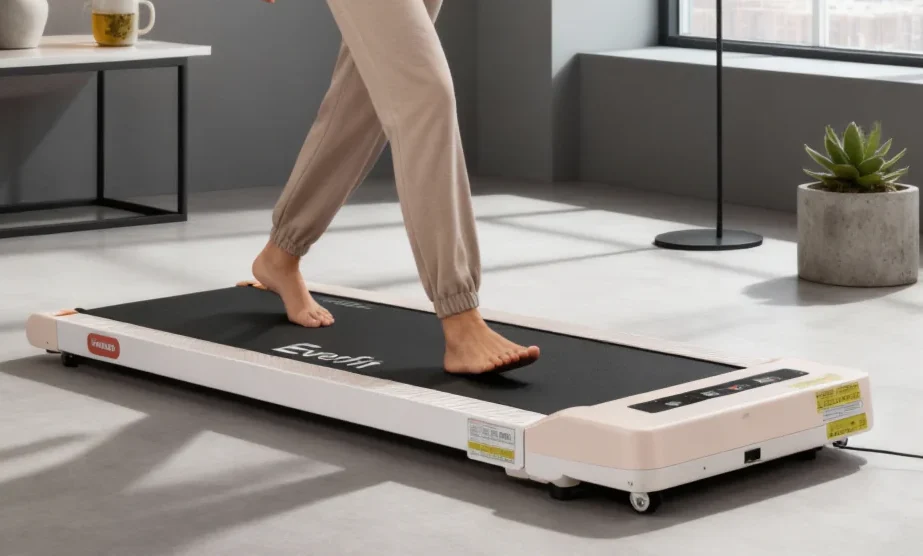
If you’re shopping for a walking pad and wondering whether it can also handle running, you’re asking exactly the right question – and the marketing copy isn’t going to give you a straight answer.
Most walking pad listings either dance around the issue or imply that “yes, you can run, with limits.” We looked at the actual specifications across 30+ models and the answer is more useful: walking pads are walking pads. A handful allow light jogging at the top of their speed range, but sustained running is outside what these machines are engineered for. If running is part of your cardio plan, you need a treadmill – not a walking pad. Here’s the data behind that conclusion, and what to look for instead.
Quick answer: No, you should not run on most walking pads. They cap at 4–6 mph and have shorter, narrower belts than treadmills. Some allow light jogging at the top of their speed range, but sustained running compromises safety, comfort, and motor durability.
What separates a walking pad from a treadmill – the spec gap that matters
Walking pads and treadmills look similar from across the room, but they’re built for different jobs. The differences show up in three measurable specs.
Speed range
According to manufacturer specifications, most walking pads cap their top speed between 3.7 and 4 mph. The basic WalkingPad A1 Pro tops out at 3.7 mph. The WalkingPad C2 maxes at 3.7 mph. Sperax’s standard walking pad models also stay under 4 mph in their advertised range. A small handful of higher-end “2-in-1” models – those that fold a handrail up to function as a light treadmill – extend their speed range to 6 or 7.5 mph. Even those higher-speed models are an exception, not the category default.
By contrast, home treadmills regularly run to 10–12 mph. Brands like NordicTrack, ProForm, and Sole list maximum speeds of 12 mph as standard for entry-level home models. The category gap isn’t subtle – most walking pads max out below the speed where light jogging begins, while most treadmills extend well past most runners’ sustained pace.
Belt size – length and width
Belt dimensions matter more than buyers realize. According to industry guidance, a treadmill belt should be at least 60 inches long to accommodate a typical running stride. Walking pads are built to a different standard: most belts are 17–18 inches wide and 45–50 inches long. That’s enough room to walk and even step at a brisk pace, but not enough for the elongated stride that running requires.
Wider belts also reduce the chance of clipping the side rail with a misplaced foot – a real safety concern at higher speeds. The 17–18-inch widths typical on walking pads compare to 20–22-inch widths on standard home treadmills. The difference in actual usable space is more meaningful than the inches suggest, especially under impact loads.
Motor capacity
Walking pad motors are built for what their name suggests. Continuous-duty horsepower ratings on most walking pads sit in the 0.75 to 1.5 HP range. Treadmills built for running typically run 2.5 to 3.5 HP continuous-duty motors – sometimes higher.
That ratio isn’t arbitrary. Running puts substantially more impact load on a motor than walking does, and motors run hotter under that load. A motor rated for walking will overheat or shorten its life span when used for running. Manufacturers often note this implicitly by excluding “improper use” from warranty coverage – and running on a unit rated for walking falls into that category.
Why running on a walking pad is risky – biomechanics and durability
The spec gap above isn’t just numbers. It translates into real risks for both the user and the equipment.
Stride length and short belts
Stride length is one of the primary biomechanical variables in running. Research published in BMC Musculoskeletal Disorders notes that stride length influences impact peak, kinematics, and kinetics – and can affect both injury risk and recovery time. When a runner is forced to shorten their stride to fit a shorter belt, their foot strike and gait pattern change. Over time, that compression can contribute to lower-limb stress.
A 47-inch belt is comfortable for walking. It becomes cramped quickly when a runner tries to extend their stride at 6 mph or faster. The risk isn’t just “feels weird” – it’s a meaningful change to how the foot lands and the leg cycles, which is exactly the variable injury research focuses on.
Motor strain and overheating
Walking pad motors are designed to handle continuous walking loads, not the impact peaks of running. Running creates higher transient loads on the motor – every footstrike under running speed transfers force differently than a walking step. Motors rated for 0.75–1.5 HP continuous duty can manage walking for hours. Push them into running speeds for sustained periods, and they run hotter than designed, accelerate component wear, and shorten the unit’s useful life. This is one reason most manufacturer warranties exclude misuse.
Stability and slip risk at higher speeds
Walking pads are designed to be light and compact – many weigh under 60 lbs and slide easily under a couch. That portability comes from a tradeoff: less mass means less stability under high-impact use. At walking speeds, this is fine. At 6+ mph with a runner’s footstrike, a lightweight unit can shift, vibrate, or feel unstable in ways a heavier treadmill won’t.
That instability at speed compounds the safety concern. Slipping on a treadmill at 7 mph is a different category of incident than missing a step at 3 mph.
Walking pad speed reality – what the numbers actually mean
Specs are abstract. Translating them into the activity they actually allow makes the limits concrete.
4 mph = brisk walking pace
For most adults, 3.5 to 4 mph is a brisk walk. It’s the upper end of comfortable walking pace and a respectable cardio workout. It’s also the cap on most walking pads – including bestsellers like the WalkingPad A1 Pro and the WalkingPad C2.
If your goal is a brisk walking workout while you take Zoom calls or read, 4 mph is exactly what you need. A walking pad delivers it.
5–6 mph = light jogging zone
Light jogging starts around 5 mph and runs up through 6 mph for most adults. A small subset of walking pads – typically the “2-in-1” models with a fold-up handrail – extend their speed range into this zone. The Sperax 2-in-1, GoPlus 2-in-1, and similar models reach 6 to 7.5 mph in their handrail-up “treadmill mode.”
Worth knowing: these models are walking pads with a treadmill mode bolted on. The belt is still walking-pad-sized. The motor is still walking-pad-rated. They allow brief light jogging – they’re not designed for sustained running. Manufacturers typically position them as “occasional jog” units, not running units.
7+ mph = running pace
Most adults run between 7 and 10 mph for typical run training. Almost no walking pads reach this speed range – and the few “2-in-1” units that approach 7.5 mph are doing it at the edge of their design envelope. A real running workout demands a treadmill, not a walking pad with extra speed settings.
Models that allow light jogging – based on manufacturer specs
If you’ve decided that occasional light jogging is part of your needs, a handful of walking pads include speed ranges that allow it. Based on manufacturer-published specifications as of these are worth shortlisting:
- WalkingPad R2 — extends to 7.5 mph in handrail-up mode. The R2 is positioned by KingSmith as a 2-in-1 that supports walking and light running. Belt and motor specs still trail dedicated home treadmills.
- Sperax 2-in-1 — typical advertised top speed 7.5 mph in treadmill mode. Folding handrail.
- GoPlus 2-in-1 Folding Treadmill — advertised speed range up to 7.5 mph. Marketed as light treadmill use.
Important caveat: we have not hands-on tested these models. The above is based on published manufacturer specifications and aggregated patterns from verified-purchase user reviews. We’re working through hands-on tests now, and our individual reviews of these models will appear in coming months.
If you actually want to run — what to buy instead
If running is part of your cardio plan, the right answer isn’t “find the fastest walking pad.” It’s “buy a treadmill.”
A folding home treadmill solves the speed, belt size, and motor problems all at once. Look for:
- Belt at least 55 inches long, 20 inches wide. This accommodates typical running stride.
- Continuous-duty motor 2.5 HP or higher. Lower motor ratings will not hold up to sustained running.
- Maximum speed at least 10 mph. This gives you headroom above your typical run pace.
- A serious folding mechanism if storage is the reason you considered a walking pad in the first place.
When we publish our walking pad vs treadmill comparison, we’ll go deep on which features matter and where the budget tradeoffs are. For now: if running is a real requirement, a walking pad is the wrong purchase.
Specs at a glance — walking pad vs treadmill
| Spec | Typical walking pad | Typical home treadmill | Why it matters for running |
|---|---|---|---|
| Max speed | 3.7–6 mph | 10–12 mph | Running pace = 6+ mph sustained |
| Belt width | 17–18 in | 20–22 in | Wider belts allow safer foot placement |
| Belt length | 45–50 in | 55–60 in | Longer belts allow full natural stride |
| Motor (continuous) | 0.75–1.5 HP | 2.5–3.5 HP | Higher HP handles impact loads |
| Folding/storage | Compact, slides under couch | Larger; some fold but bigger footprint | Trade-off: portability vs capability |
Spec ranges drawn from published manufacturer documentation across the major walking pad and treadmill brands. Individual models vary.
Pros and cons of attempting to run on a walking pad
| Pros (rare cases) | Cons (common cases) |
|---|---|
| Some 6+ mph models allow brief light jogging | Most cap at 4 mph — too slow for running |
| Compact and quiet for the home | Short belts compress natural stride length |
| Cheaper than running-rated treadmills | Motors not rated for sustained high-speed loads |
| Stability decreases at higher speeds | |
| Voids warranty on most models if used for running |
A walking pad is right for you if…
- Your goal is walking — not running.
- You want low-impact cardio while working, reading, or watching.
- Space and noise constraints rule out a treadmill.
- You’re comfortable with brisk walking (3.5–4 mph) as your top intensity.
A walking pad is NOT for you if…
- You want to run, even occasionally.
- You’re training for a 5K, 10K, or anything that requires sustained speed work.
- You weigh near or above the unit’s weight capacity (running adds significant impact load).
- You expect treadmill-grade durability under high-impact daily use.
Frequently asked questions
Is it bad to run on a walking pad?
Yes, in most cases it is. Walking pads are engineered for walking pace — most cap below 4 mph and use motors rated for continuous walking, not running. Running on one places strain on a motor it wasn’t designed to handle, compresses your natural stride on a belt that’s too short, and can void the manufacturer’s warranty under “improper use” exclusions. The risks are split between the user (slip, stride compression that may contribute to injury over time) and the equipment (motor wear, shortened lifespan). A small subset of “2-in-1” models with fold-up handrails allow brief light jogging at 6+ mph, but those are still designed around walking-pad-sized belts and motors.
What is the difference between a walking pad and a treadmill?
Walking pads and treadmills are different machines built for different uses. Walking pads cap their speed between roughly 3.7 and 6 mph, use 17–18-inch-wide belts that are 45–50 inches long, and run on motors rated 0.75–1.5 HP continuous duty. Home treadmills built for running reach 10–12 mph, have 20–22-inch belts that are 55–60 inches long, and run motors rated 2.5–3.5 HP continuous. Walking pads are also far more compact, often under 60 lbs and designed to slide under a couch. Treadmills usually fold but still have a larger footprint and weight. The right pick depends on whether you want walking or running as your primary use case.
Can you jog on a walking pad?
Light jogging is possible on a small subset of walking pads — the “2-in-1” models with fold-up handrails that extend speed range to 6 or 7.5 mph. Standard walking pads that cap at 3.7–4 mph cannot accommodate jogging in any meaningful sense. Even on the higher-speed 2-in-1 models, light jogging is what they allow occasionally, not sustained jogging. The belt and motor are still walking-pad-sized. If jogging is a regular part of your routine, a treadmill remains the better fit.
How fast can you go on a walking pad?
Most walking pads cap between 3.7 and 4 mph — that includes bestsellers like the WalkingPad A1 Pro and C2. A higher-speed subcategory of “2-in-1” walking pads with fold-up handrails extends the range to 6 or 7.5 mph; this includes models like the WalkingPad R2, Sperax 2-in-1, and GoPlus 2-in-1. Even the fastest walking pads top out below the speed where most adults’ running pace begins, which is why true running demands a treadmill.
Will running damage a walking pad?
Running on a walking pad accelerates wear on the motor, belt, and supporting components — and most manufacturer warranties exclude “improper use,” which can include using a walking-rated machine for running. The damage isn’t usually instant; it accumulates. Belt wear shows first, motor strain follows, and controllers can become unresponsive after exposure to higher heat loads. If your goal is occasional light jogging on a 2-in-1 model, manufacturers typically permit it. If your goal is sustained running, the wear curve will outrun the warranty quickly.
The honest takeaway
Walking pads are walking pads. They’re optimized for the use case the name describes, and they do that job well. The right walking pad makes brisk walking workouts easy to slot into your day, takes up minimal space, and operates quietly enough for shared rooms or video calls.
Running is a different category of activity, and walking pads aren’t engineered to support it. If running is part of your cardio plan, a folding home treadmill is the right purchase — not the highest-speed walking pad. The honest version of this advice often costs us a sale, but it’s the version that prevents readers from returning a product disappointed three weeks in.
If walking is your goal, see our beginner’s guide to walking pads for what to look for. If you’re still weighing the broader walking-pad-vs-treadmill decision, our complete comparison goes deeper.